The 168-Hour Week: Why the Fight for Paid Caregivers is Personal
I want to talk about a sensitive topic: paid caregivers.
Right now, at a federal level, there is a lot of talk about dismantling or strictly limiting paid family caregiver programs. People have different beliefs on whether this should be a covered service, but for families like ours, it isn’t a theoretical debate. It’s a matter of survival.
So let’s get real, and let’s get personal.
The Myth of "Typical" Care
There is a common misconception that utilizing paid caregiver benefits means "living off the state" or being unwilling to work. Now, don’t get me wrong: there are definitely people who abuse this benefit. That happens in almost every system. But for the vast majority of families, that simply isn’t the case.
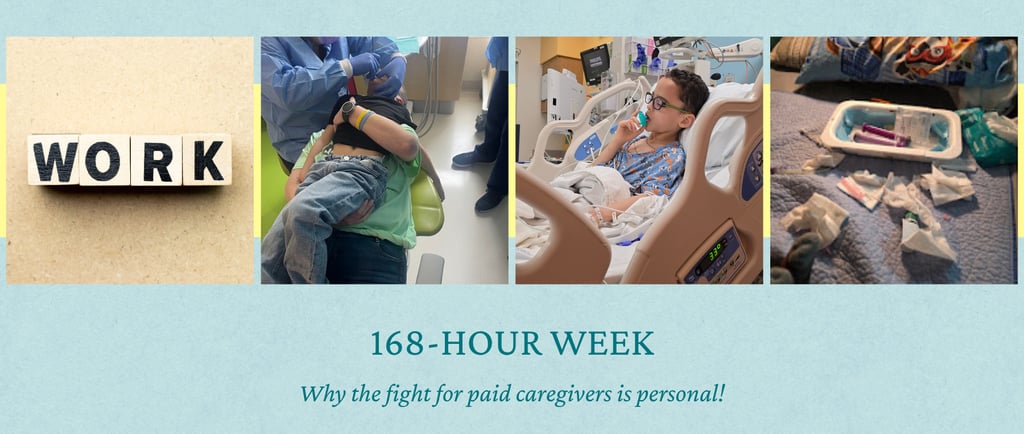
The raw reality is that some individuals require a level of care that far exceeds "typical" daily life. We are talking about life-sustaining medications, complete assistance with every basic need (brushing teeth, dressing, eating), and total physical assistance with transfers just to move around the home. Some individuals require 24/7 monitoring. The labor doesn't stop.
The 40-Hour Gap
We need to talk about the specific piece that currently affects so many families in my state: providing paid caregiver hours to family members for those 40 hours a week outside of their approved nursing or home health aide hours.
Even when a family is approved for Private Duty Nursing (PDN), those hours rarely cover the 168 hours in a week. Usually, the primary caregiver is already providing a massive amount of "unapproved" hours.
But then, you have the call-outs.
Between the hours that insurance refuses to approve and the constant nursing call-outs, caregivers are actually expected to provide well over 70 hours of hands-on medical labor every single week.
The "Impossible Math" of Employment
How is a caregiver supposed to work a traditional 40-hour job on top of that? How do you maintain a career when:
You are the only backup when a nurse calls out (which happens more than people realize).
You have to manage endless medical appointments, therapy sessions, and equipment deliveries.
Your "reliability" as an employee is constantly at war with your "reliability" as a caregiver.
Most employers won’t keep an employee who can’t guarantee their presence, but caregivers can’t make those guarantees. There isn't a facility we can use so we can go to an office. Even for those of us working from home, you cannot give 100% to a company while providing life-sustaining care to a loved one.
The Insurance "Squeeze"
To make matters worse, we are seeing a disturbing trend. Insurance companies are now expecting families to increase their own "natural" hours of care specifically to justify a decrease in PDN hours.
It is a double-sided squeeze: the federal government wants to cut the pay for the work we do, while insurance companies want to increase the amount of work we do for nothing. They are asking family members to absorb high-level medical labor for free so they can save on the professional help they are supposed to provide.
Why This Program is Essential
By approving these 40 hours for the family caregiver, the system is finally acknowledging that this is work. It is essential, skilled labor that keeps our loved ones safe and at home.
Dismantling this program doesn't "send people back to work." It simply forces families to choose between financial ruin and the health of their loved one. We aren't asking for a handout; we are asking for the system to recognize the 168-hour reality of the labor we are already doing.
What Can You Do?
This isn't just my story; it’s the story of thousands of families across the country. If you want to help protect these essential lifelines, here is how you can take action:
Share Your "Caregiver Math": If you are a caregiver, share this post and add your own reality. How many hours of medical labor do you provide outside of approved help? Putting a number on our labor makes it harder for officials to ignore.
Contact Your Representatives: Let your state and federal representatives know that paid family caregiving isn't just a "benefit"—it is a critical part of the healthcare infrastructure. Tell them that cutting this service actually costs the state more in the long run by forcing institutionalization.
Educate Others: Many people outside of our community simply don't know that "nursing hours" don't mean "full coverage." Share the reality of the 168-hour week to help break the stigma.
Contact
Questions or ideas? Reach out anytime!
info@summerjoydesigns.com
© 2025. All rights reserved.